1915 – 1977
One Hundred Years of History
1915: George E. Winkler of Victoria found chalcopyrite float (chips) on the beach near the mouth of the Jordan River. He traced the float up the river to its source on the east wall of the canyon. On July 30, Winkler and Associates staked the claim later known as Sunloch. On September 15, they staked the nucleus of the Gabbro Group. Further claims were added to these groups in 1917, when J.M. Turnbull, R.H. Stewart and Jack Hanna staked the Gabbro, Adalain and War Eagle.
1917: Winkler bonded the Sunloch Group to R.H. Stewart & Associates of Vancouver, who organized the Sunloch Mining Company. That same year, a narrow gauge railway was constructed and diamond drilling, as well as surface and underground work commenced.
1919: The Consolidated Mining and Smelting Company of Canada acquired a majority interest in Sunloch. (In 1966, the company would change its name to Cominco.)
1920: Further drilling, cross-cutting and drifting continued. The erection of a concentrating plant was postponed because of high costs and an unfavourable copper market at the time. With George E. Winkler at the helm as Managing Director, Gabbro Mines further explored the claims and conducted addition surface prospecting and underground work for the next few years.
Mid-1920s to 1948: Low commodity prices and World War II resulted in the mine being dormant for almost 30 years.
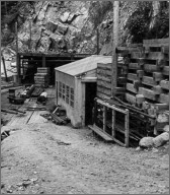
1949: Sunloch and Gabbro were optioned from their owners by Hedley-Mascot Gold Mines. They conducted extensive diamond drilling for a couple of years and installed electrical transformers and compressors near the former BC Hydro penstock intake. Entry to the mine was from adits (surface entrances) along the riverbank. The company milled 600,000 tonnes.
1956: The two properties were consolidated under the name ‘Sunro Mines Limited.’
1960: Cowichan Copper obtained an operating lease from Consolidated Mining (Cominco), which had owned a major interest in the mine since 1919.
1961: Rehabilitation of the surface plant and installation of the underground mill commenced.
1962: Underground mill was completed, and full production commenced on May 1st.
1963: Production ceased due to flooding when a stope (tunnel) carved through the bed of the Jordan River. The flooding caused the 5,100 level main adit to collapse in several places. The cave-in at 1,700 feet went through to surface and the subsequent flooding caused considerable damage. The flooding was eventually stopped and six bypasses created around the caved areas on the 5,100 level.
Total production from May 1962 through Dec 1963 was 411,684 tons yielding 3,034 ounces of gold, 33,311 ounces of silver and 13,221 pounds of copper.
1965: Sheep Creek Mines Limited agreed to provide management for Cowichan Copper. (They later changed their name to Aetna Investment Corporation.) They located a concentrate storage system and shops at the portal. Production continued strongly for the next four years but ceased in November 1968, when the copper price dropped to $1.06/kg.
1972: Cominco transferred operations to Jordan River Mines.
1973 – 1976: Considerable development of the mine was conducted by Jordan River Mines Ltd. They were in full-scale production until the end of 1974, when the copper price dropped to $1.41/kg but continued on a smaller scale until 1977, when there was cave-in along the access tunnel.
1977: In early January, underground production from the Sunro Mine ceased due to partial caving of the underground workings, leaving a significant amount of partially developed but un-mined resources. Fortunately, no-one as hurt.
To ensure the mine remained inaccessible, the BC Ministry of Mines instructed Cominco to install a 34-metre long rock plug in the tunnel. It was 2,010-meters from the portal near the point where it joins the mill room. Workers and equipment could still enter the mine through the river adits.
From 1962 to 1976, about 1,464,595 tons of material was extracted from Sunro Mine to produce:
13,754,271 kg Copper
2,262,651 grams Silver
203,101 grams Gold.